Upload your image, and the tool automatically sets the target size to 3.5×2.5 cm, so you do not need to enter the width and height manually. If you need a different size, you can change the dimensions and switch between cm, pixels, mm, and inches according to your requirements. This is especially useful when a form, application, document, or photo specification requires an exact physical image size.
Fit the Photo Without Distortion
Choose Crop Fit when you want the image to fill the 3.5×2.5 cm frame while maintaining its proportions. Choose Fixed when the complete photo needs to remain visible and you are comfortable using background padding, or use Stretchy when filling the exact dimensions is more important than maintaining the original proportions.
DPI Support for Specification-Based Photos
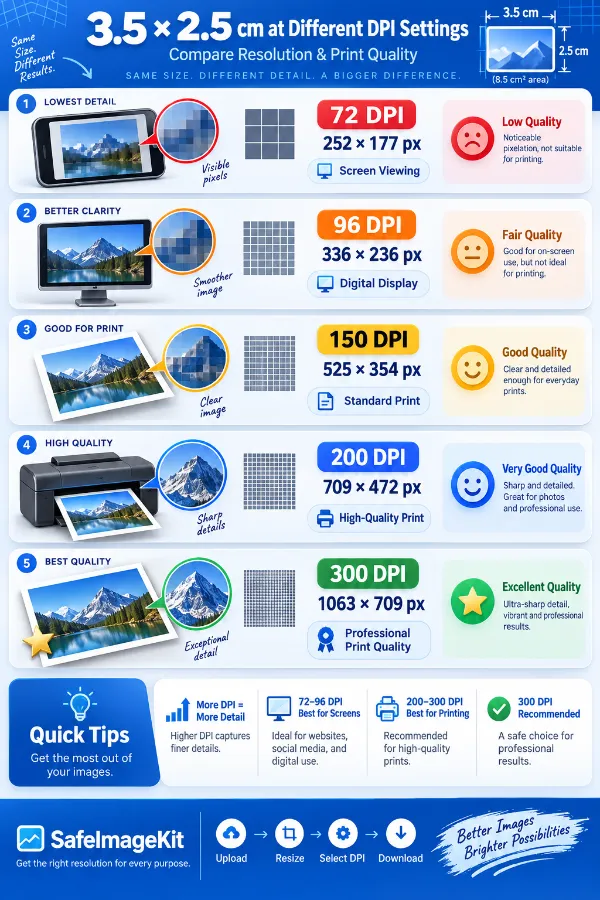
The tool provides 72, 96, 200, and 300 DPI options, allowing you to match a stated photo requirement. For example, if an application specifies 3.5×2.5 cm at 200 DPI, you can set the physical dimensions and DPI directly instead of manually calculating and entering pixel values. This makes the tool particularly useful for workflows where both the physical size and resolution are specified.
Adjustable Image Quality
Choose the image quality from 0.1 to 1 based on how you want the resized image to look and perform. A higher quality setting can help retain more visual detail, while a lower setting can help reduce the resulting file size. This gives you flexibility when the resized image needs to meet a specific quality or file-size requirement.
Advanced Editing Options
A 3.5×2.5 cm requirement may come with additional specifications, so the tool provides controls beyond physical dimensions. You can adjust quality from 0.1 to 1, zoom from 25% to 200%, rotate 90° left or right, flip horizontally or vertically, and choose square or circular output shapes.
Multiple Input and Output Options
You can bring an image into the tool from your device, drag and drop, Google Drive, or Dropbox, giving you several ways to start the resize process. After editing, you can export the result as PNG, JPG, JPEG, WebP, or GIF, depending on what the destination requires. This is useful when a photo specification combines dimensions with an accepted file-format requirement.
Steps to Resize Image to 3.5×2.5 cm
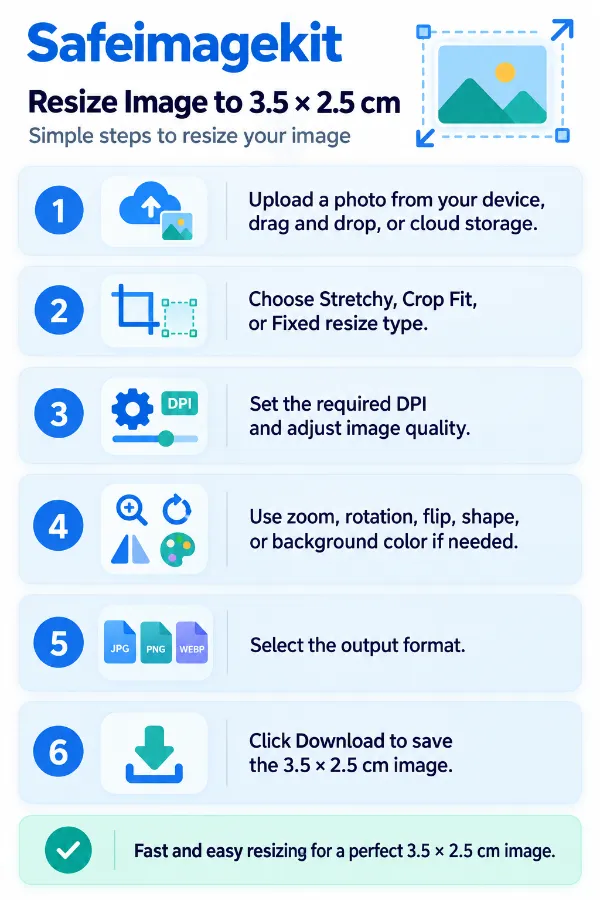
1 . Upload a photo from your device, drag and drop, or cloud storage.
2 . Choose stretchy, crop-fit, or fixed resize methods accordingly.
3 . Set the required DPI and adjust image quality.
4 . Use the zoom, rotation, flipping, shape, or background color when necessary.
5 . Select the output format.
6 . Click Download to save the finished image of 3.5×2.5 cm size.
Other useful information
Explore our visual guides and infographics
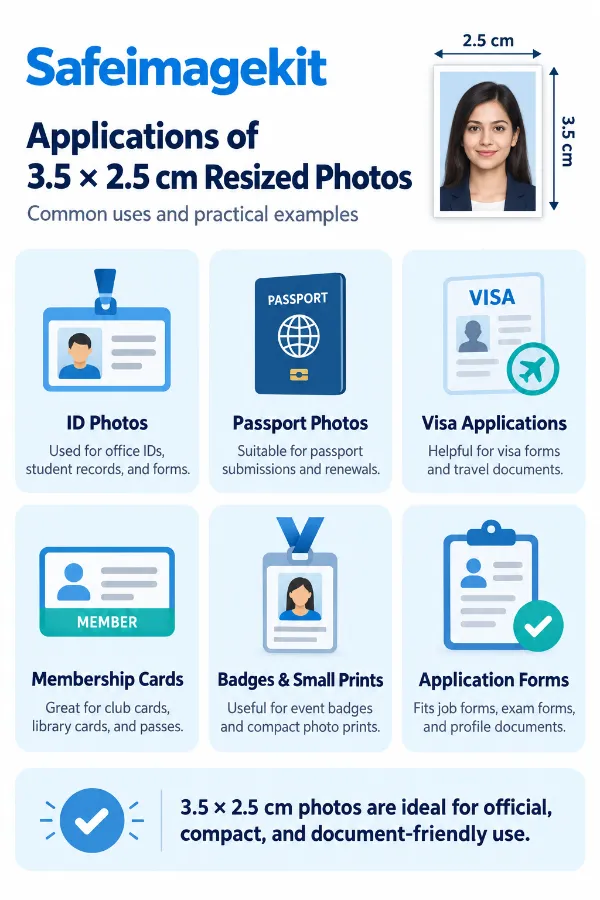
The infographic highlights common situations where a 3.5 × 2.5 cm photo size can be useful.
The infographic explains how to set the image dimensions to 3.5 × 2.5 cm and save the resized photo.
The infographic shows how a 3.5 × 2.5 cm image changes in pixel dimensions at different dpi settings.
×
Frequently Asked Questions
Why would someone need a photo that is exactly 3.5x2.5 cm?
Some forms, applications, cards, certificates, records, and document systems specify photo dimensions in centimeters rather than pixels. An image that merely looks like the correct size may still be rejected if its actual dimensions do not match the requested 3.5×2.5 cm specification.
What are the pixel dimensions of a 3.5x2.5 cm photo at 200 DPI?
At 200 DPI, 3.5×2.5 cm corresponds to approximately 276×197 pixels. The exact pixel representation depends on the DPI selected, which is why setting both the physical dimensions and DPI in the tool is preferable when a specification provides both.
What should I select if the requirement says “3.5x2.5 cm, 200 DPI”?
Upload the image and select 200 DPI. You can then choose the appropriate image format and quality based on the remaining requirements of the destination.
Can I create a 3.5x2.5 cm photo in JPEG format?
Yes. After uploading the image, select JPG or JPEG as the output format before downloading. This is useful when the receiving website or application specifically accepts JPEG photographs.
How can I make a 3.5x2.5 cm image fit without stretching the photo?
Use Crop Fit if you want the image to fill the entire 3.5×2.5 cm area while preserving its proportions. Some of the original image may be cropped, but people and objects are less likely to appear unnaturally stretched.
How can I keep the entire photo visible inside 3.5x2.5 cm?
Choose Fixed mode. The original image is kept within the specified dimensions and the unused area is filled with background padding, which can be customized using a color or HEX code.
Which mode should I use if the original photo has a different aspect ratio?
It depends on what matters most. Crop Fit is useful when the 3.5×2.5 cm frame must be filled, Fixed is useful when the entire image must remain visible, and Stretchy is suitable when exact filling is more important than preserving proportions.
Can I use a vertical photo for a 3.5x2.5 cm requirement?
Yes. You can upload a portrait-oriented image and use the fitting controls to place it inside the required 3.5×2.5 cm dimensions. Depending on the original proportions, Crop Fit or Fixed may be preferable to Stretchy.
Can I choose a background color for the 3.5x2.5 cm photo?
Yes. Select Fixed mode when you need padding and choose the required background color. You can also enter a specific HEX color code when a particular background shade is required.
What does the lock aspect ratio do when resizing a photo to 3.5×2.5 cm?
The Lock Aspect Ratio option keeps the original proportions of the photo while you adjust its dimensions, helping prevent unwanted distortion. If the photo must meet the exact 3.5×2.5 cm specification, you can unlock the ratio and set the width and height independently to match the required size.
What does 200 DPI mean for a 3.5x2.5 cm image?
DPI describes the image's resolution relative to a physical measurement. When a requirement says 3.5×2.5 cm at 200 DPI, it is specifying both the physical size and the resolution that should accompany that size.
Is 200 DPI better than 72 DPI for a 3.5x2.5 cm photo?
Neither is automatically better for every purpose. If the destination specifically requests 200 DPI, use 200 DPI rather than selecting another value simply because it is higher or lower.
Can I resize the image to 3.5x2.5 cm and keep the file below 50 KB?
You can use the tool's quality control from 0.1 to 1 to reduce the resulting file characteristics, but the final file size depends on the original image, content, dimensions, format, and compression. If a destination has a strict 50 KB maximum, check the downloaded file size before submitting it.
Why is my 3.5x2.5 cm JPEG still larger than 50 KB?
Physical dimensions alone do not determine file size. A photograph with lots of detail, textures, colors, or compression-resistant content can remain relatively large even after being resized to 3.5×2.5 cm.
Can I reduce the quality if my 3.5x2.5 cm photo exceeds the file-size limit?
Yes. The tool provides a quality range of 0.1 to 1, allowing you to reduce the output quality when the destination imposes a file-size restriction. It is best to lower quality gradually and check the resulting image for acceptable visual clarity.
Can I resize a private or personal photo to 3.5x2.5 cm without sending it to a server?
Yes. The tool performs the image processing locally in your browser, so the resize does not require sending the image file to a remote resizing server. This can be useful when the image contains personal information or is otherwise confidential.
Can I zoom the photo before creating the 3.5x2.5 cm output?
Yes. The zoom control ranges from 25% to 200%. This can help reposition the visible portion of the photo when you need better framing within the 3.5×2.5 cm output.
Can I change the shape of a 3.5x2.5 cm image?
The tool provides options to keep the original shape or change it to a square or circle. However, if the destination specifically requires a rectangular 3.5×2.5 cm photograph, retaining the required rectangular dimensions is generally the appropriate choice.
Why does my 3.5x2.5 cm photo looks cropped after resizing?
This usually happens when Crop Fit is selected and the original photo has a different aspect ratio. The tool removes portions that extend beyond the required 3.5×2.5 cm frame so that the remaining image completely fills the requested dimensions.
Why would I use rounded corners on an image?
Rounded corners can help an image fit better into modern layouts, profile graphics, cards, website sections, and visual designs where sharp rectangular corners do not match the surrounding style. The effect can also make repeated image elements look more consistent.
What information can I check in an image's EXIF data?
EXIF data can contain technical information recorded with a photograph, such as camera-related details and other metadata associated with the image. The Read EXIF tool can be used to inspect the available metadata rather than relying only on what is visible in the picture.
Over 500k Users Rely on Our Image Editing Tools Monthly
Join a growing community of creators who trust safeimagekit.com for versatile image editing and processing solutions.
We appreciate your feedback and will use it to improve our services.
About The Author
RK Shree - A science enthusiast with a poetic flair, and possesses an insatiable desire to explore diverse fields seeking new knowledge and experiences. My work ethic is highly disciplined and dedicated. I take pleasure in pursuing creative endeavors that captivate me.