Turn your image into a 300×300 pixel square without manually entering the dimensions. This is useful for profile images, thumbnails, forms, icons, and other areas that require a fixed square size. Simply upload your image and download the prepared 300×300 result.
Select the Appropriate Resize Method
Use Crop Fit to fill the square while keeping the original proportions, or choose Fixed to keep the complete photo with padding when needed. With Fixed mode, you can select a background color or enter a custom hex color for the extra space around the image. Stretchy is also available when you want the image to fill the entire square, even if its proportions change.
Set DPI and Quality for Your Needs
Choose a DPI from 72 to 300 based on whether the image is intended for digital or print-related use. Adjust the quality from 0.1 to 1 to balance image clarity and file size. If a specific website, application, or printer gives you a required setting, use those specifications
Make Quick Image Adjustments
Fine-tune your image with 25%–200% zoom, 90° rotation, horizontal or vertical flipping, and shape options. Choose Original Shape, Square, or Circle depending on how you want the final image to appear. These controls let you make quick changes without using a separate image editor.
Multiple Image Upload Options
Upload an image directly from your device, drag and drop it into the tool, or import it from Google Drive or Dropbox. You can choose whichever method is most convenient for where your image is stored. This makes it easy to start resizing without moving the image between different apps.
Choose the Right Format or Size
Download the finished image as PNG, JPG, JPEG, WebP, or GIF depending on your intended use. You can also enter different dimensions and choose pixels, centimeters, millimeters, or inches when you need a size other than 300×300. This gives you flexibility to use the same tool for other image requirements.
Steps to Resize an Image to 300×300
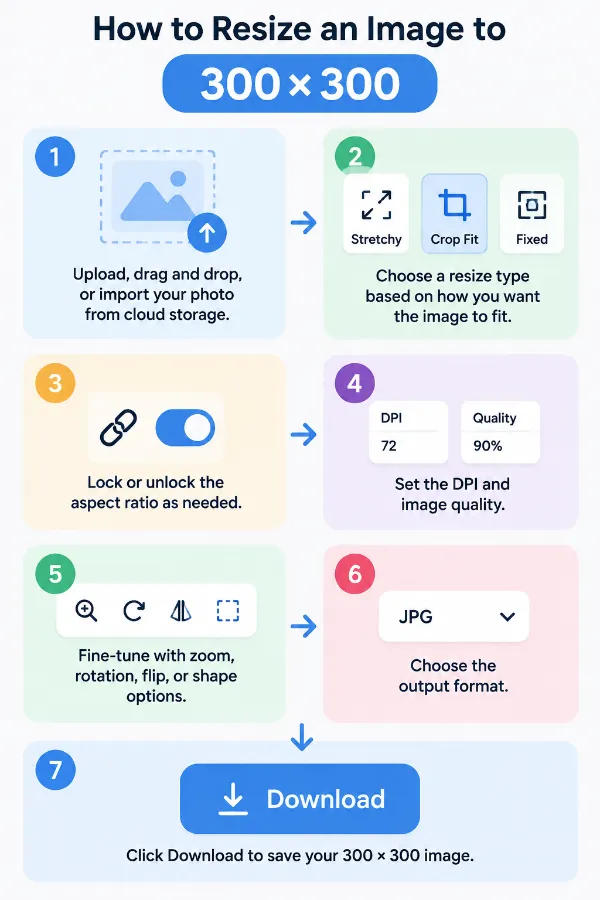
1 . Upload, drag and drop, or import your photo from cloud storage.
2 . Choose a resize type based on how you want the image to fit.
3 . Lock or unlock the aspect ratio as needed.
4 . Set the DPI and image quality.
5 . Fine-tune with zoom, rotation, flip, or shape options.
6 . Choose the output format.
7 . Click Download to save your 300×300 image.
Other useful information
Explore our visual guides and infographics
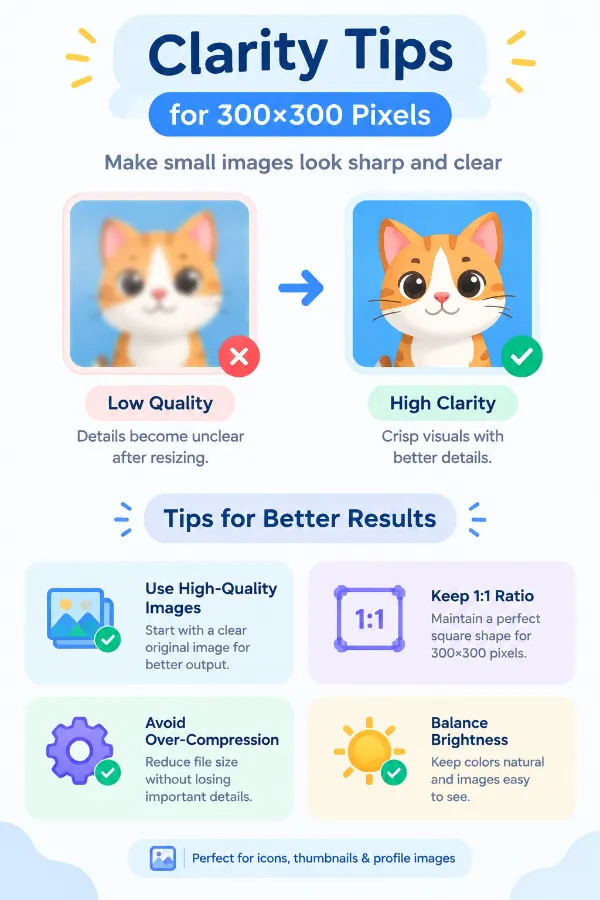
The infographic shares simple ways to keep 300 × 300 pixel images clear and well-defined.
The infographic outlines the process of setting an image to 300 × 300 pixels and saving the resized file.
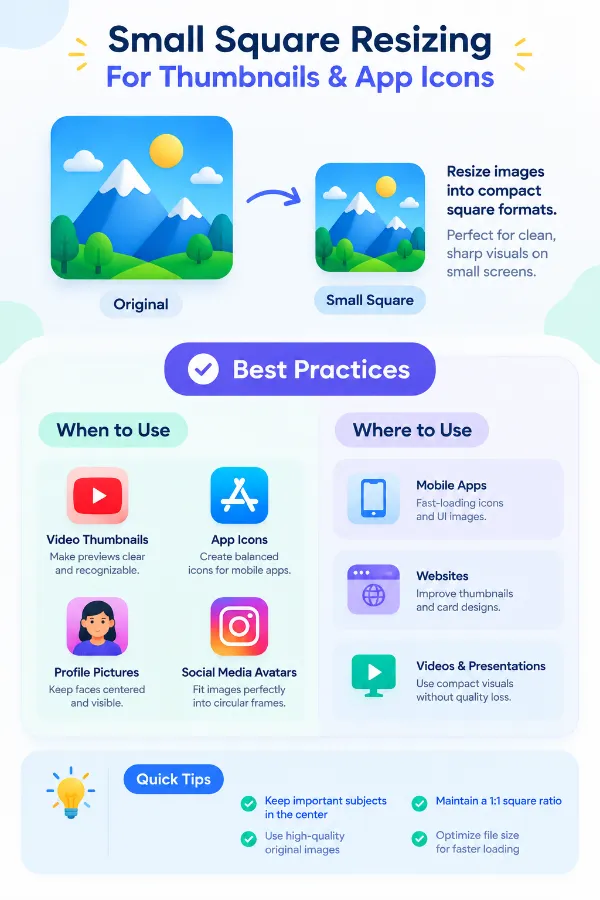
The infographic shows how 300 × 300 pixel images can be prepared for thumbnails, app icons, and other compact digital graphics.
×
Frequently Asked Questions
What can a 300×300 image be used for?
A 300×300 image can be useful for profile images, thumbnails, product images, icons, avatars, forms, website elements, and other square layouts.
Is 300×300 a good size for a profile picture?
A 300×300 pixel image can be used for profile images on platforms and services that accept square profile photos, such as Discord, WhatsApp, and some website or application profile systems. Since these platforms may resize or crop profile images during display, starting with a square image helps keep the proportions consistent.
Will a 300×300 image look clear on a large screen?
Image clarity depends on more than the dimensions alone. A 300×300 image may look sharp at its intended display size, but enlarging it significantly can make the image appear soft or pixelated. For larger displays, using a higher-resolution source may be more appropriate.
Can I use a 300×300 image as a website thumbnail?
Yes. A square 300×300 image can work well for thumbnail layouts that require equal width and height. Before uploading it, check whether the website has a maximum file size, supported format, or different recommended dimensions.
What physical size is a 300×300 image at 300 DPI?
At 300 DPI, 300 pixels correspond to 1 inch, so a 300×300 pixel image represents approximately 1×1 inch at that density. The physical size changes if a different DPI is used, which is why pixel dimensions alone do not define the printed size.
What DPI should I use for a 300×300 image?
For ordinary screen or web use, DPI is generally less important than the actual 300×300 pixel dimensions, and 72 or 96 DPI may be suitable depending on the workflow. For small print-oriented work, 200 or 300 DPI can be more appropriate, with 300 DPI commonly used when higher print density is required. If a printer or organization specifies a DPI, follow that requirement.
Does changing DPI make a 300×300 image higher resolution?
Not necessarily. If the image remains 300×300 pixels, changing the DPI does not add more pixels or create additional image detail. DPI mainly changes how those pixels are interpreted in relation to physical print dimensions.
Does lowering quality change the 300×300 dimensions?
No. The pixel dimensions can remain 300×300 even when the quality setting is changed. Quality mainly affects how the image is encoded and can influence visual appearance and file size rather than changing the specified width and height.
Which format should I use for a 300×300 photograph?
JPG or JPEG is usually a practical choice for photographs because it can provide good visual quality with a relatively manageable file size. PNG may be preferable for graphics or situations where lossless output is important, while WebP can be useful for web-oriented applications.
Is WebP better than JPG for a 300×300 image?
Neither format is universally better. WebP can provide efficient compression and is useful for many web applications, while JPG has very broad compatibility and is commonly accepted by websites and applications.
Why is my 300×300 image larger in file size than expected?
File size depends on factors such as image content, output format, compression, quality setting, and whether the image contains complex details. Two images with identical 300×300 dimensions can therefore have very different file sizes.
Why does my resized 300×300 photo look blurry?
If the original image has low resolution or lacks detail, resizing it to 300×300 cannot recreate information that was not present in the source. Blurriness can also be influenced by the selected output quality and format. Starting with a clear, sufficiently large source image generally gives a better result.
Can I turn a 300×300 image into a circle?
Yes. The shape controls allow you to choose Original Shape, Square, or Circle. Selecting Circle changes the visual shape of the output while keeping the image preparation within the same workflow.
Why would I use a circular 300×300 image?
A circular version can be useful for avatars, profile graphics, badges, or designs where a round image is preferred. Whether you need an actual circular file or simply a square image that will be displayed as a circle depends on the requirements of the destination.
Can I use Zoom to make the subject larger inside the square?
Yes. The 25%–200% zoom control lets you adjust the viewing scale of the image before downloading. This can be useful when the subject occupies too little or too much of the available area, although the final result also depends on the selected fitting method.
What is the purpose of flipping a 300×300 image?
Flipping creates a mirrored version of the image. A horizontal flip reverses the image from left to right, while a vertical flip reverses it from top to bottom. This can be useful for certain graphics, compositions, or images where the direction of the subject needs to be changed.
Can I use a different unit instead of pixels?
Yes. In addition to pixels, the tool supports centimeters, millimeters, and inches. This is useful when your requirement specifies a physical measurement rather than a digital pixel size.
Can I create a different image size after using the 300×300 option?
Yes. You are not limited to the 300×300 pixel option. You can enter your own dimensions and select the appropriate measurement unit when you need another size for a different project or application.
Can I prepare the same image for several different uses?
Yes. You can use the original image to create different outputs by changing the dimensions, shape, fitting method, quality, DPI, and file format as required. For example, you might create a 300×300 JPG for one application and a different-sized PNG for another.
Does resizing to 300×300 remove the original image from my device?
No. Creating a resized version does not mean that the original photograph itself has to be replaced. You can download the processed 300×300 pixel version while retaining your original file separately on your device.
How can I change a specific color in an image without recreating the entire design?
If an image contains a color that you want to replace, you do not always need to edit the whole image manually. A color replacement tool can help change a selected color while leaving other parts of the image unchanged. This can be useful for adjusting backgrounds, changing design colors, creating alternate versions of graphics, or experimenting with different color combinations.
How can I add a border around an image before sharing or publishing it?
Adding a border can help separate an image from its background or give it a more finished appearance. An image border tool lets you add a visible edge around the picture without the need to create it manually. You can use borders for photographs, social media graphics, thumbnails, posters, and other designs where an outlined edge improves the presentation.
How can I make the corners of a rectangular image rounded?
Upload the image to the Round Image Corners tool and apply the rounded-corner effect. This can give photographs, cards, thumbnails, screenshots, and other rectangular graphics a softer appearance.
Over 500k Users Rely on Our Image Editing Tools Monthly
Join a growing community of creators who trust safeimagekit.com for versatile image editing and processing solutions.
We appreciate your feedback and will use it to improve our services.
About The Author
Hey there! I'm Aditya Thakur, a dedicated technology enthusiast with a strong passion for music and anime. I tackle challenges head-on and consistently strive for excellence. In my past time, you can find me indulging in my favorite tunes or exploring captivating anime worlds.